REGULAR EXERCISE · SMALL EVERYDAY HABITS · 5 MIN READ
One-Minute Movement: Small Bursts That Add Up.
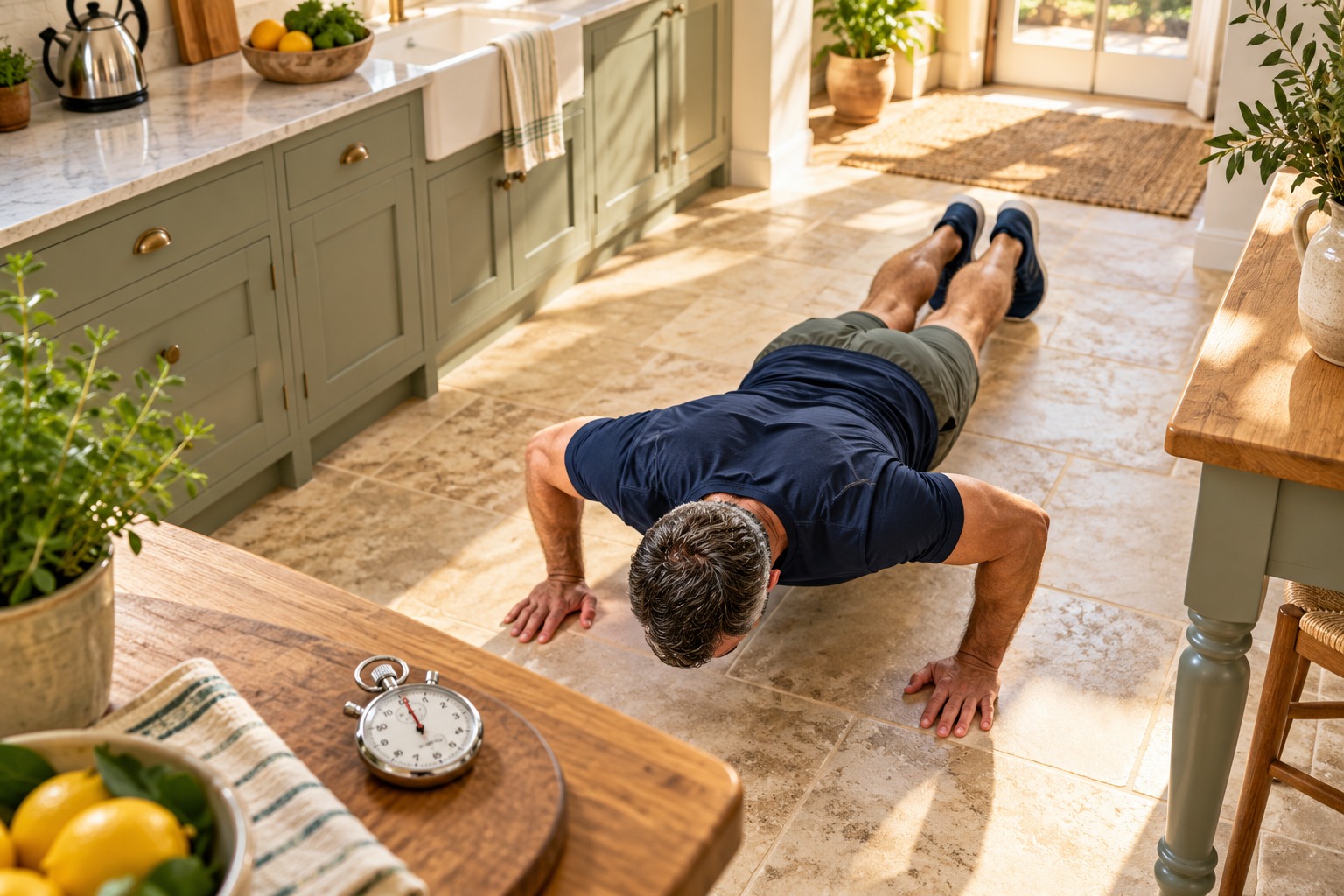
A minute while the kettle boils. Another between calls. Put a few spare moments to work with movements that fit your day and your starting point.
Healthy Baseline · Updated 12 October 2026
Credit: AI-generated illustration for Healthy Baseline.
The kettle is boiling. A file is downloading. You have finished one call and the next has not started. There is a minute available—and, almost by reflex, the phone fills it.
What could we achieve with those small pockets of time? A minute here, a minute there. A few movements while the day carries on around us.
It is a useful thought for men who want to stay capable but do not have a spare hour waiting conveniently between work and dinner. A small burst of activity will not transform the day on its own. It can still be a better use of that minute than another scroll.
Why a small amount of movement still matters
Regular Exercise is one of our nine principles because movement supports the heart, circulation, muscle function and metabolic health. The principle is the need to move. The habit is finding ways to make that happen in an ordinary day.
Activity does not have to arrive in one large appointment. Short periods can contribute to an active week. What you do, how much you do and the effort involved still matter: a gentle stretch and a brisk walk are useful in different ways.
Researchers sometimes call brief activity bouts “exercise snacks”. That does not mean every pause has to become a sweaty sprint. Our starting point is simpler: notice a spare minute, choose a suitable movement and repeat it when the opportunity fits.
Four things a minute can give you
A break in the sitting. Stand up and walk a short distance, or use a comfortable movement that suits your mobility. You have interrupted an otherwise static stretch of the day.
A little practice with strength. A few controlled sit-to-stands or wall press-ups give familiar movements a place in the routine. The number matters less than being able to do them comfortably and well.
A lower barrier to starting. A full session may feel awkward to fit in. One manageable action is easier to begin, particularly when you are rebuilding a habit.
A cue you can use again. Linking movement to something that already happens—such as finishing a call—gives the next small break an obvious place to belong.
Choosing the stairs can turn an ordinary journey into a little movement. Credit: AI-generated illustration for Healthy Baseline.
A small menu for a spare minute
Choose one option, rather than racing through them all. Clear a little space and use a version that fits your starting point.
Walk: take a short circuit of the room, corridor or garden. Walking at a purposeful pace is an option if it is comfortable and the space is suitable.
Take the stairs: choose them instead of the lift or escalator when suitable for you. A purposeful ascent can add a brief effort to a journey you were making anyway. Keep the pace controlled, use the rail where needed and stay aware of other people; this is not a race against the kettle.
Sit and stand: rise from a stable chair and sit down slowly. Use support if needed, and stop before control starts to disappear.
Wall press-ups: use a clear, stable wall and a comfortable position. A floor press-up is optional; you do not have to audition for the marines while making tea.
Supported heel raises: hold a stable support and rise gently onto your toes, then lower under control, if suitable for you.
Move while seated: comfortable seated marching or another movement you know suits you can be a starting point. Standing is not the only way to take an active break.
There is no compulsory target of 20 repetitions. Nor do you need to fill the whole minute. Keep breathing naturally, choose an effort you can manage, and stop if something hurts. Stay clear of hot appliances and slippery floors. If an injury or condition limits activity, get advice about suitable movements.
Do ten spare minutes make ten useful minutes?
They certainly make ten minutes of activity. What they contribute depends on the movement, effort and your wider routine. Gentle breaks are worthwhile, but they are not automatically equivalent to the same time spent at a moderate or vigorous intensity.
Start with one or two opportunities you actually remember. You can add another later. The aim is more movement across the day, alongside walks, strength work or other activity you enjoy—not a rule that every quiet moment must be productive.
What does the research suggest?
A large UK study examined brief bursts of vigorous everyday activity in more than 25,000 adults who reported no regular leisure-time exercise. Their average age was about 62, and the group included more than 11,000 men. Short bursts were associated with lower mortality over the following years.
This is relevant to men in midlife, but the study included both men and women and observed activity rather than assigning it. It cannot prove that the brief bursts caused the difference, or that a gentle movement break has the same effect. The useful message is that activity woven into daily life deserves attention—not that a stopwatch guarantees a result.
Let the little wins belong to the bigger picture
Regular Exercise and Strengthening the Core are the obvious connections. Focus and Productivity can help you notice the gap between tasks; Rest and Relaxation reminds you that a break is allowed to be a break too.
Keep water available, eat properly and give recovery its place. Small bursts add movement to those foundations; they do not replace them.
Next time the kettle goes on, you might put the phone down and try a comfortable movement away from the hot counter. Or finish a call and walk to the window. A minute here, a minute there: a modest habit with room to grow.
ONE THING TO TRY
Choose one everyday cue—such as finishing your first work call—and use the next spare minute for one comfortable movement. Repeat that cue this week.